Skip to content

News

No results articles found

  • Get Familiar: Black Sherif

    Get Familiar: Black Sherif

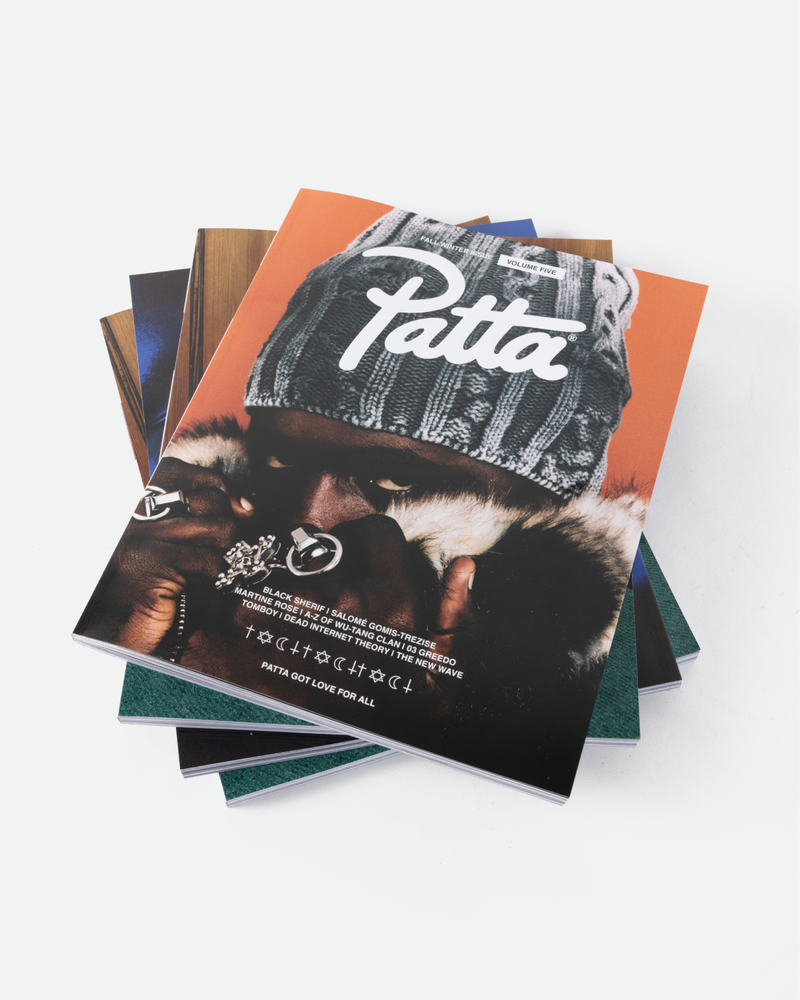
    Interview by Passion Dzenga | Photography by Akadre Studio | Styling by Sonia IhuomaIf you haven’t already tapped into the world of Black Sherif, now’s the time to get familiar. The Ghanaian genre-bender has come a long way since his First Sermon days, evolving from a hometown hero into a global voice with a message rooted in resilience, spirit, and raw emotion. With a sound that blurs the lines between drill, reggae, highlife, and rap—and a style just as genre-defying—Blacko is the kind of artist who makes you feel something, even if you don’t understand the language.It’s been a busy year for the 23-year-old, whose real name is Mohammed Ismail Sherif. We spoke days before the release of his sophomore album Iron Boy, and the start of an arena tour across the US and UK. Sherif is entering his Iron Boy era with the quiet confidence of someone who’s lived, learned, and levelled up. He’s got love for his roots, love for the journey, and love for the people who see power in vulnerability—because for Black Sherif, that’s the real flex. We caught up with him to talk about patience, performances, personal growth, and the power of staying true to your source. Let’s get into it.You’ve come a long way since your debut album. How do you reflect on your growth as an artist? How have you changed over time?It’s been quite a journey—from The First Sermon to where I am now, preparing to drop my sophomore album. A lot has changed, especially in terms of how the world receives me and how the business works. But one thing that hasn’t changed is where my creativity comes from. The source remains the same. What has changed is me—I’ve grown. I’ve learned patience, and I’ve learned acceptance. Two or three years ago, things that happen to me now would've broken me. Today, I handle them with a different mindset. I respect the journey. As kids, we think success will come instantly—we write goals in our notes and expect them to happen on our timeline. But life teaches you patience.Patience really does sound like the defining theme of your journey. Would you say that’s the biggest lesson so far?Absolutely. Patience. This album, for instance, was supposed to drop eight months ago, but life happened. If I didn’t have patience, I would’ve crashed out. Learning to sit back, be part of a team, and let things unfold—that’s been everything.Your sound is a unique mix of drill, rap, reggae, and highlife. How did you develop this blend? And what role do your Ghanaian roots play in that?I don’t think I’ve ever said this before, but confusion helped me find my sound. I know how to do so many things, and I used to judge myself a lot—I'd write something and wish it sounded like reggae or something else. But then I let go. I stopped fighting the flow and started letting whatever came out, come out. The result is this unique mix. It’s not forced. It’s just who I am and what I’ve been exposed to—from Ghanaian music to Caribbean influences.Highlife is such a traditional Ghanaian genre. How does it find its way into your music, especially when you’re blending so many Western sounds?I even get surprised sometimes. I’ll be working with my in-house producer, Joker, and he’ll make these futuristic beats—but the rhythms, man, they just scream highlife. It’s not about language or lyrics. It’s in the rhythm, the melodies. And somehow, that same beat my Jamaican friends will hear and say, "This sounds Caribbean!" It’s wild.Different things, but especially my mom. I remember being 10; that was the last time I was home with her. And the music that shaped me came from those early years. My dad came back from Greece when I was eight and introduced me to Don Carlos. “Harvest Time” was the first reggae song I learned. That shaped my idea of what music and art should be. Also, I still have friends from when I was six or seven; we’re still close, some of us even work together now. Those relationships keep me grounded.You’re known for being vulnerable in your music. How do you manage that vulnerability while still showing strength and power in your art?I find power in being vulnerable. Not everyone can do that. I see vulnerability as a superpower. There are so many people in the world who can’t speak or express what they’re feeling—but I can. And I have a space to do it through music.You’ve worked with big names—Burna Boy, Vic Mensa, Mabel, Fireboy DML. What do you look for in a collaborator, and how do those collabs shape your sound?Funny enough, I don’t think I’ve fully entered my collaborative phase yet. Most of the songs I’ve done came from relationships—someone sent me a track, and I vibed with it. But after this album, I want to travel, sit with artists, connect spiritually, and create. To me, music is spiritual. A perfect collaboration is when everyone’s spirit aligns on a track. That’s the kind of collab I’m chasing.What sort of themes, sound, and your evolution as an artist on this second album?It’s more elevated. Some of the beliefs I had two or three years ago—I’m challenging them now. I’ve found new ways to be personal and vulnerable. There’s a song called One that talks about something that happened to my father last year that changed everything in my family. It’s a spiritual album. You’ll have to listen to it to feel what I’m saying.The album is called Iron Boy. What does that title mean to you?The title is layered. First, it’s a tribute to a highlife legend from where I’m from—Iron Boy was his nickname. But also, "iron" represents being tough. The stuff I’ve been through recently? If it had happened three years ago, I would’ve stopped making music. But now, I’m iron. I’ve become that.You’ve been called the voice of the Ghanaian youth. How do you carry that responsibility, and how do you reflect your community’s struggles in your work?I've learned we all fight the system in different ways. For me, music is how I respond. I’m honest in how I reflect what’s around me. Where I’m from—Zongos—you don’t often see guys being this vulnerable. They’ll say, “Being soft gets you nowhere.” But I say it anyway. And that gives me power.You mentioned a track called “Victory Song”, where you open up about crying in a hotel in London. Why was that moment important to share?Because no one talks about that part of success. People see you on stage or travelling, but they don’t see the moments when the noise fades, and you’re alone with your thoughts. That moment reminded me that I’m still that kid from back home, feeling things deeply. I want people to hear that. That’s the kind of artist I want to be.You’ve played massive shows—MOBOs, Wireless Festival, City Splash. What’s that experience like, and what stands out to you?Every time I get on stage outside of Ghana, I tell myself, “Nobody here knows me. I’m here to sell them something I believe in.” At Wireless, the sound was so good I forgot I was performing to a huge crowd. It felt like a rehearsal. I just wanted two hours to sing.What makes a great performance to you?There are some things about performing that you have to learn, even if you're born with talent. When I watch people like Kendrick Lamar, their performances feel like an emotional roller coaster. Some songs don’t need dancing; they just need to be felt. You get more from watching the artist express it through gestures and facial expressions. I love all of that because I don’t think I’m a good speaker, but I’m super talented in nonverbal communication. That’s why I believe I’m one of the best performers from where I’m from.You mentioned Kendrick. Are you aiming for a stage show that feels more like a play or theatre performance than just a concert?Yeah. It’s more than just turning up. It’s about creating an experience. Like theatre, with costumes and pacing.You’re considered one of the best-dressed men from Ghana. What sparked your interest in fashion?It came from when I was young. My whole style started in a woman’s closet—my auntie's. When my mom left for Greece, I stayed with my auntie, and she had all kinds of stylish stuff. I’d sneak into her things, steal belts, and glasses. That’s when I got into appearances. I also tried different hairstyles, like one called “backbone,” and got beaten for it because it was too bold for where I was living. I’ve always been chasing freedom to dress how I want.Did your mom’s background as a seamstress influence your fashion sense?Definitely. I used to sew my buttons for school. Even in high school, I’d alter my clothes because I couldn’t afford a tailor. If I didn’t like something about a shirt or a pair of sneakers, I’d cut it and make it my own.Last September, you walked for Labrum at London Fashion Week. What’s your relationship with high fashion?I’m just getting into it. As a teenager, I couldn’t afford real designer clothes, so I wore replicas. But now, I get these things as gifts, and I feel like I have a fashion dream that will come true. After walking for Labrum, people told me I was natural at it. I thought I didn’t do a great job, but the reactions were strong. I’m still figuring out my way in fashion, but I believe in it.How do you see your style connecting with your music?Iron Boy is a supernatural being, and how he looks shouldn’t be relatable. The music and visuals are all extensions of each other. How I sing, how I dress, how I look—it’s about making people feel something, even if they don’t understand the words.Tell us about your music video for the song “So It Goes” with Fireboy DML.I loved the styling. I didn’t style Fireboy, but I was involved in my own styling. Some of the looks feel like video game characters. When I was a kid, I was really into gaming—GTA, Winning Eleven, and Sega. I don’t play as much now, even though I have a PS5, but those inspirations still show in my visuals.What’s the concept of the music video?It’s like a greeting from abroad. The character is on his way to war, like a traveller sending a postcard to a lover. You see him on a horse, surrounded by dead men—it’s poetic and emotional.As a Ghanaian artist gaining international recognition, how important is it to remain rooted in your language and culture while appealing to a global audience?I think my music speaks globally, even in a different language. Some people in Ghana don’t get what I’m saying, and people abroad do—emotionally. Emotions and melodies are universal languages. I’m still learning how to reach everyone, but I believe in the power of feelings.Find out more about Patta and the world around us through the Patta Magazine Volume 5, which is available now only at Patta Chapter stores in Amsterdam, London, Milan and Lagos.
    • Get Familiar

    • magazine

  • Shawn Alexander Allen for Patta Magazine

    Shawn Alexander Allen for Patta Magazine

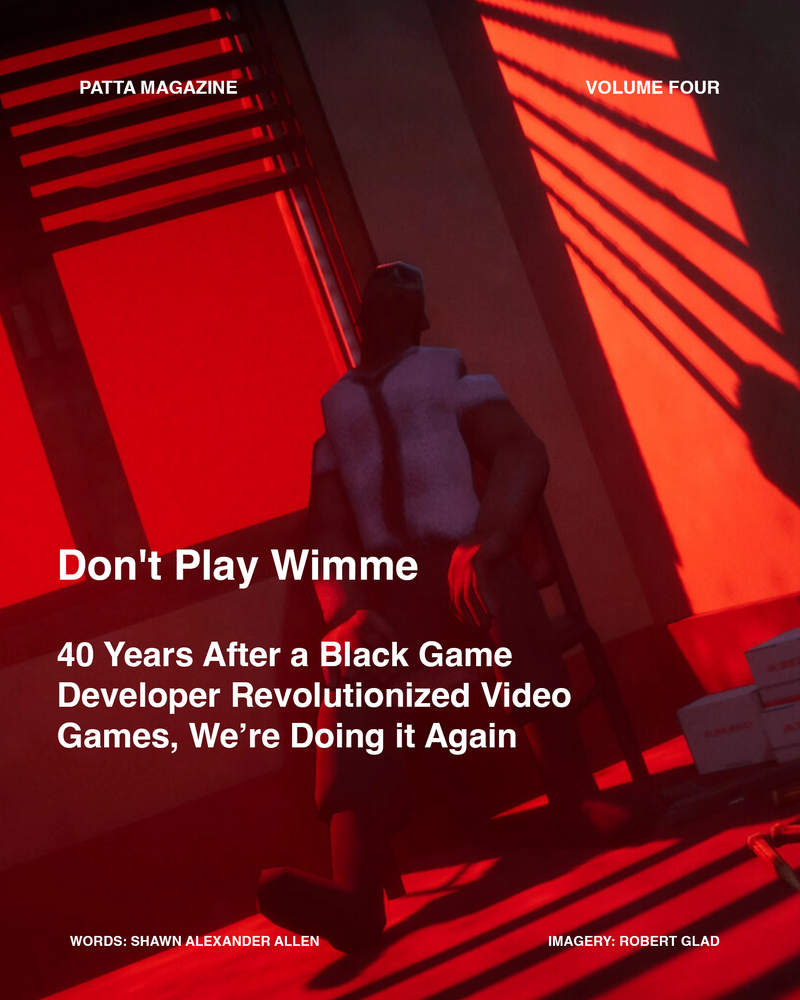
    Words: Shawn Alexander AllenYou may be wondering, ‘but Shawn! There’s a list of - counts fingers - one, two … TEN great characters I can list! Miles Morales, Franklin from GTA, the NPCs in Horizon Zero Dawn, Travis Scott in Fortnite, and the Carlton dance and… and… I mean, I could go on!’ And you’re absolutely right. Those characters do exist. Some of them are good, great even. But here’s the thing: how many Black people were involved in bringing those characters to life? How many were in charge of those teams? And why does the “Killmonger” haircut have the games industry in a chokehold? The key answer to these questions, and more, is what I said, that Black representation in games is bullshit.First, let me introduce myself. I run an independent game development company that pushes culture forward in games. I’ve worked at Rockstar Games and Major League Baseball, and I’ve released all manner of games, from tiny story-based games to VR home run derbies and, of course, some of the biggest games in the world. The first game I shipped at Rockstar was GTA (ed. Grand Theft Auto, among the best-selling video games ever) IV, after all.  Now that that’s out of the way let me give you a brief history of how we got here. Most early games with Black characters in them were sports games, and that representation was all over the place, with characters ranging from pixelated abstractions of the visages of athletes and sports-adjacent celebrities to straight-up racist stereotypes. Sure, there was Mike Tyson’s Punch-Out!!! (where he was the bad guy?), but there was also Frank Bruno’s Boxing with a character called “Tribal Trouble” who looks like the worst stereotype. He even had a bone through his nose. Sometimes there’s a Black character who was “2P”, as in 2nd Player. Like in the Taito game Crime City, where the first character looks like Mel Gibson in Lethal Weapon (aka Martin Riggs), the Black “2P” character looked like… a random Black guy in a suit. While they got Gibson’s looks down pretty well, they couldn’t even bother infringing on Danny Glover’s likeness a little bit.For a while, the Black character was always the 2nd Player, and/or a sports player, and/or a celebrity. There was M.C. Kids, an official (and batshit insane) McDonalds game, where the Black kid on the cover is … the 2nd player. At least he’s on the cover? There’s a whole host of basketball games, and even Will Smith and Jazzy Jeff were in NBA Jam. And then there’s fighting games and the beat ‘em up sub-genre where Black folks were once again, the 2nd or 3rd tier character, usually with the white guy up front and center. In fact beyond white characters, the 2nd most prevalent beat ‘em up characters were the Ninja Turtles. Are the Ninja Turtles Black?For me, the first really great Black character in a game was Micheal Leroi from Shadowman on the N64 in 1999. He was a Blaxploitation character who had to travel to hell and kill a bunch of white serial killers to save the world, which I was completely on board with. A Black dude IRL at least voiced him. His co-star, “Agnetta” had the worst wannabe voodoo accent, and with the help of IMDB many, many years later, I found out she was a VERY white woman.  Fast-forward and Black characters have definitely gotten better. But not because the industry wanted them to. It took some very key people to move the culture forward and bring about the best Black characters, and it was only the independent games uprising of the 2010s that we really saw a change in WHO makes the games. This is even more egregious when you look at how games REALLY got their start. I found out, with much of the world in the 2000s that Jerry Lawson, a Black programmer and technological innovator, was key in advancing the tech that allowed the games industry to exist as it does today. He was part of the team that made the Fairchild Channel F, the first game console to use cartridges, which paved the way for everything since. He also founded his own company and developed some games, but he saw his company destroyed by the video game market crash in the ‘80s. It seems only fitting that a Black man who innovated in a mostly white industry would get lost in the shuffle because that is the story of the games industry and representation. The fact that the industry made billions on cartridges, and Jerry Lawson’s name only began popping up decades later, is basically the story of American business. (Look up Uncle Nearest) Why does this even matter, right? ‘They’re just games!’ They’re for recreation! Maybe you don’t even pay attention to your character's appearance in the games you play, which is obviously a lie, but you do you. These are popular refrains from folks who claim to be fans of games while being fine with the cultural stagnation of the medium. I’ve even seen supposed Black folks proudly beat their chest about how they are “gamers” and don’t care about representation on message boards and social media, often trying to refute a Black person asking, ‘Where the Black people at?’ I’m not sure who they are trying to gain brownie points with, but that ain’t it.  Games are a cultural art form like film, music, comics, animation, you name it. In fact, games, video games specifically, can encapsulate ALL other art forms, which is super special and should be celebrated. For me, as a Black kid who had aspirations as a musician, a comic artist, an animator, and a film director at one point in time, when push came to shove, video games, with their unique interactive elements was the one true artform that could satisfy what I wanted to do with my own art. That's what I do. I make cool art, as I am an artist and writer first and foremost, and I work with dope musicians, including some of the biggest and best indie Hip-Hop artists including Open Mike Eagle, Mega Ran and AIRCREDITS, to make my games even cooler. But beyond me, there’s a small but mighty contingent of independent Black game developers who are bringing the representation to games but not through tokenism or “forced diversity” (I mean, all fiction is “forced” to exist, ya dig?) but through sheer force of will in making their art. A few years back, a budding developer by the name of Derrick Fields reached out to me. They wanted to know the ins and outs of game dev. We had a great conversation, and now, Derrick has their own studio Waking Oni Studio, making games with a fusion of Japanese and Black art. The first release was the very fun Onsen Master across multiple platforms.  Very recently I met C.Bedford who is a relatively new face to games. They are an amazing illustrator with a poppin’ instagram and they took their talents to work with their partner on their first game, Sorry We’re Closed, a neon, queer reenvisioning of Silent Hill, and they worked with Okumura, an amazing rap duo with an energizing flow, to make their soundtrack pop. Someone who always seems like a fresh face, even if he’s been around for a minute, is Xalavier Nelson Jr. who is a powerhouse writer and design director (who got his start writing about games at the age of 12 by tricking websites into thinking he was an adult). Between himself and his label Strange Scaffold he’s put out a staggering number of games, with my favorite being El Paso, Elsewhere, a neo noir horror love story where you slow down time and blow away werewolves, vampire mummies and biblically accurate angels as the coolest low polygon Black protagonist this side of Shadow Man. It can be a bit daunting seeing the new talent coming through, because I often wish I had been able to make my own games decades ago. It’s weird to accept that I’m sort of an “elder” in the space, but I am comforted by knowing Justin Woodward, a fellow OG in the games industry, who I met about a decade ago at EVO, the world’s biggest fighting game tournament. He was demoing Super Comboman, an offbeat fighting platformer which had such an amazing art style. But Justin had a lot more going on. Beyond his company Interabang Entertainment, he has his other brands, including the MIX games, where he’s put out some dope retro inspired games including Jay and Silent Bob: Mall Brawl, and Rugrats. Speaking of the MIX, it’s also an event, serving as the premiere way to get indie games in front of the press, and has been for over a decade. The year after I met Justin he was running the indie space at EVO.I could go on and on, because even if we’re a small group, I know and love so many of the Black folks who are sticking around despite the difficulties of our industry. I’ve worked in the nonprofit mentorship/accelerator space for almost a decade now, and the success of Black folks means a lot to me.Something very telling is how several of these titles have this raw, visceral creativity behind them. I’d say directly, my game, Treachery In Beatdown City, as well as El Paso, Elsewhere, and Sorry We’re Closed have this unflinching “Blaxploitation” era style of eschewing the norms of the industry, taking existing genres and making them very Black, where we can fight power structures and win, just like in Blaxploitation films. One day I got a text from a few colleagues telling me that TreaAndrea Russworm, a professor at University of Southern California, was lecturing about Treachery in Beatdown City and its direct connections to Blaxploitation. I felt a very warm feeling that day.This representation, the full spectrum of Blackness on display through writing, directing, art direction, music composition, and more - is how you achieve real, transformation in the industry that has no way of just being turned off because we are here to stay. There was a time where we (the collective Black people in games) were being asked by those in the press, “Will video games have their Black Panther moment” reacting to the massive cultural success of the movie. The answer is complex, and requires a mapping of history. In short, Black Panther was a confluence of many different cultural forms coming together that simply wouldn’t exist without the Blaxploitation era of film. I wager video games are just now hitting their Blaxploitation era. But as we’ve seen with the history of games, they grow quick and fast as a culture, so maybe we’ll see it sooner than later.
    • magazine

  • Baloji for Patta Magazine

    Baloji for Patta Magazine

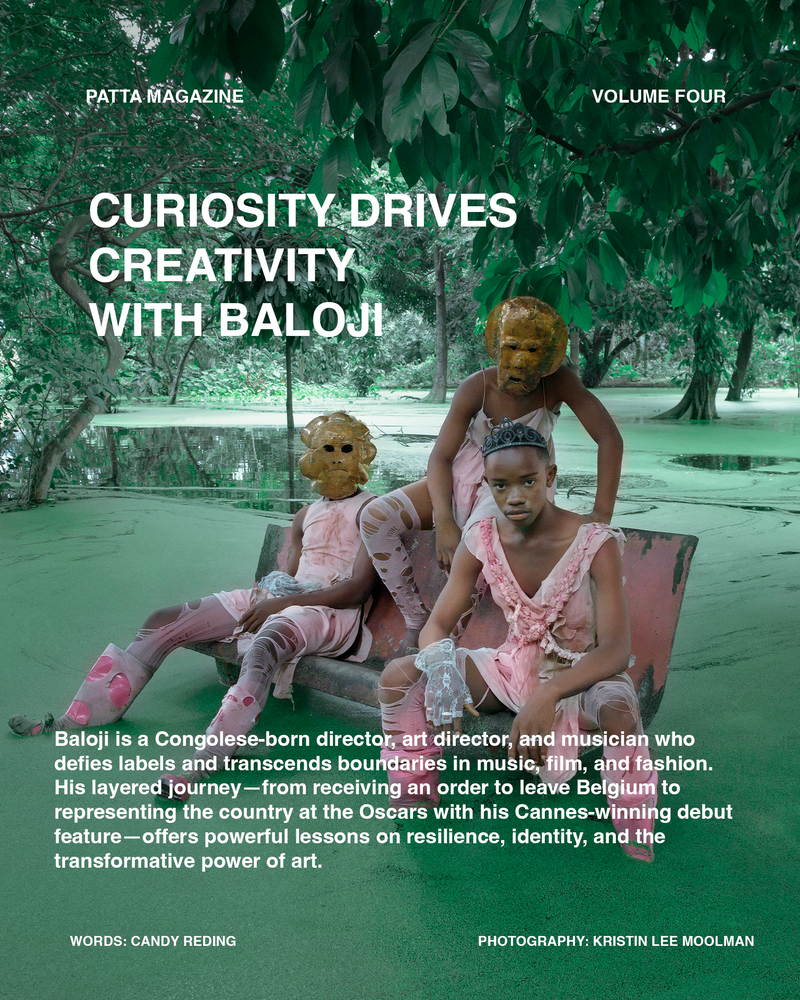
    Photography by Kristin Lee Moolman | Words by Candy Reding Baloji is a Congolese-born director, art director, and musician who defies labels and transcends boundaries in music, film, and fashion. His layered journey—from receiving an order to leave Belgium to representing the country at the Oscars with his Cannes-winning debut feature—offers powerful lessons on resilience, identity, and the transformative power of art.For Baloji, identity has always been a dual-edged sword, both a question to navigate and a declaration to uphold. His name, translating to “man of science” in Swahili, originally held a sense of pride and purpose. Yet under colonial Christian evangelism, the name morphed into something far darker, twisted into meaning “sorcerer” or “man of occult sciences.” In a world deeply rooted in spiritual traditions and Christian beliefs, his name became a stigma, a provocation, and a challenge. “It’s like calling yourself the devil or a demon in Europe,” he explains. Growing up as a young boy in Belgium, the misunderstanding of his name led to a sense of displacement and alienation. It made people uneasy, forcing him inwards to find ease. “It wasn’t about embodying silence; it was about breaking it,” he reflects, offering a glimpse into the resilience that has since become his signature.Baloji’s path as an artist has been defined by his refusal to accept the limits placed on him. A self-taught creator who built his craft through exploration and persistence, he shaped his artistic identity within the resourceful and rebellious culture of 90s hip-hop. “Hip-hop is the real DIY,” he says, recalling how it taught him creativity and self-reliance. “You’re making your own flyers, photos, fanzines. My specialization was rap, but that naturally evolved into graffiti, graphic design, and architecture. Dance taught me about the movement of damaged Black bodies. DJing and sampling opened my ears to the music of other cultures; Caribbean, Latin American, and even my Congolese heritage.” This constant expansion of his creative field allowed him to embrace his roots while beating the expectations often placed upon them.Baloji’s journey as an artist began with a leap into the unknown when he joined the Belgian hip-hop group Starflam in 1998. It was a transformative moment, “Starflam taught me about life,” he reflects because “I was an undocumented, illegal teenager. I had an order to leave the country and was far from my family.” This disconnection from the familiar, paired with the hardships of his undocumented status, could have stifled his potential. Instead, it fueled his artistry. Through Starflam, Baloji learned to channel his inner world, turning his emotions, struggles, and dreams into powerful lyrical narratives. The collective gave him the tools to survive and thrive, crafting an identity rooted in self-expression and rebellion against societal constraints. This period laid the groundwork for his multifaceted career.While Baloji’s creative independence is unmistakable, collaborators and mentors who believed in his vision have also shaped his journey. Among them was the late Virgil Abloh, whose innovative spirit left a lasting impression. “I learned so much from Virgil”, Baloji shares. “He could move from one project to another without losing focus and was always open to other designers. He supported the Augure film project because it aligned with his mission to uplift Black women and, by extension, Black-owned businesses.” Abloh’s spirit of collaboration and cultural pride resonates deeply with Baloji. His excursion into fashion marks yet another exciting chapter: "I'm working a lot on the fashion and art direction aspect at the moment because I've gained confidence in my skills and aesthetic choices by working with professors at the Fashion Academy in Antwerp.” For Baloji, fashion is about garments and storytelling, how costumes, art direction, and narration create a cohesive and transformative visual language.Fashion, however, is not a newfound interest but a natural extension of his lifelong appreciation for craftsmanship. As he excitedly explains, "I've got a few fashion projects coming up, and I'm working passionately on the crafts that I've discovered by being a great aficionado of Belgian designers.” From Martin Margiela to Anthony Vaccarello, Baloji draws inspiration from the greats. He also admires icons like Karl Lagerfeld, particularly his work with Métiers d'Art, which combines tradition and modernity in high fashion.For an artist whose work resists labels, the interplay of cultural traditions is central to his creative process. Whether in music, film, or fashion, Baloji treats symbols and narratives with a curiosity that invites exploration and connection. “I read the newspaper, I listen to author podcasts, I read biographies, even 50 Cent's is a gold mine, full of knowledge. Culture is about reaching out, stepping out of your comfort zone, and learning from others,” he says. This philosophy extends into his personal life, where he immerses his young daughter in a broad spectrum of experiences. From waacking events - waacking is a street dance style - to art galleries, Congolese snack bars to Korean neighborhoods, opera houses, and street basketball courts, Baloji ensures that she grows up understanding the value of diversity. He says that different opinions and perspectives build character, and that’s something “I want her to carry forward.”The turning point in Baloji’s career came with his evolution from music to filmmaking. This shift, while natural in hindsight, was filled with challenges. He reveals that he went to the European Cinema Commission (the non-profit association that supports filmmaking in Europe) “26 times between 2012 and 2022, and they only gave me the green light once.” Despite the promises of diversity and meritocracy often preached in the industry, the experience disillusioned him. They make you believe in the idea of “when you want it, you can (get funding), but it’s a lie. It’s about knowing who has the power to make it happen.” Despite these barriers, Baloji’s persistence paid off. His film Omen (known locally as Augure) received international acclaim, showcasing his ability to tell deeply resonant stories across mediums. Yet he remains grounded, crediting much of his success to the support of his family. “I owe so much to my daughter’s mother, who supported me through four years of filmmaking without income or certainty. She’s my luck.”Freedom, strength, and rebellion run like threads through Baloji’s work, but these qualities did not come without struggle. He speaks candidly about the sacrifices he has made for his art, describing a pivotal moment when he poured 25k of his own money into a film project. “My cinematographer told me: ‘25K is what I pay for my house mortgage.’ I don’t have a house; I’m still renting. But I see that sum as an investment in my art, in fighting for it to exist despite the obstacles.” For Baloji, creation is a form of resistance and determination. His projects are not simply about aesthetics but about narrative, depth and meaning. “People misunderstand my work; they think it’s just about images. But the visuals tell a story. They look easy to imitate, but it’s the flow of ideas that counts. Execution changes over time, but the narrative is what endures.”Strangely, Baloji’s recognition in the film world solidified his broader reputation. As the president of the Camera d’Or at Cannes, he found himself in a position of respect within an industry that had long resisted his inclusion. “I think I’m one of the first self-taught filmmakers to win a prize at Cannes and represent a country at the Oscars.” His film Augure (known as Omen internationally) was the Belgian entry for Best International Feature Film at the Oscars in 2023. But there’s still a long way to go in breaking glass ceilings for creative minorities and Black men. However groundbreaking, Baloji’s achievements are only one step in a larger journey toward systemic change.Despite the seriousness of his work, Baloji finds ways to invite lightness into his life. “There’s a lot of humor in my films and my work in general, but it’s secondary at first sight”, he explains. Humor is the politeness of despair, but so is poetry. When it’s time to decompress, he turns to simple pleasures: traveling, cooking, watching soccer (his beloved Real Madrid), or indulging in the freedom of not setting the alarm. These moments of lightness, however small, are vital to his sense of balance.Peace, for Baloji, remains an evolving concept. “I don’t know if I’m at peace with my past, but not having all the answers keeps me alert. It inspires me to keep fighting for myself, my loved ones, and for change.” Through his art, he challenges certain ideologies and redefines what it means to belong. “Art shapes how we view identity and culture, but curiosity drives creativity,” he says. With this insatiable curiosity and a refusal to accept limits, Baloji continues to transcend boundaries, inspiring others to embrace their roots while daring to create something entirely their own. Baloji is not just a symbol of resilience; he invites us to dream bigger and create fearlessly.The Patta Magazine Volume 4 will be included for free with each online order of the Patta Angelwings T-shirt while stock lasts. 
    • magazine

Error